
[ PRODUCT STRATEGY ]
Strategy informed by execution, not by slides.
Roadmaps that survive contact with tooling. BOM cost models grounded in factory quotes. Stage-gate programs run by people who have shipped the products they planned. ONMOTIO act as the strategic layer between your idea and the production line.
25+ products launched. 8 industries. 95% on-time delivery on programs we own. Strategy work behind KORU, eXalt Aircraft, and HiRail.
[ IS THIS FOR YOU ]
Strategy work with us is the right move if…
[ A GOOD FIT ]
- You have a product idea and need a credible roadmap before you raise, hire, or commit to tooling.
- You're between concept and tooling and want a stage-gate program run by people who have done it before.
- You need BOM cost engineering and pricing modelled at 1K, 10K, and 100K units, not on the back of a napkin.
- You need a vendor strategy: who manufactures it, where, at what MOQ, and on what terms.
- You're a non-technical founder who needs a fractional Head of Product to coordinate design, engineering, and the factory.
[ PROBABLY NOT ]
- You only need a market study or brand positioning deck, that's a strategy consultancy job → Get a referral
- You already have a Head of Product and just need design or engineering execution → Browse services
- Your product is software-only, our work is hardware-shaped → Talk to us

[ IN PRACTICE ]
KORU: from idea to a 1000% Indiegogo, on a roadmap that held.
KORU came to us with a vision and a deadline. We wrote the product requirements, modelled the BOM at three production volumes, sourced the contract manufacturer in Shenzhen, and ran the stage-gate program from concept to crowdfunded launch. Pricing held, lead times held, and the campaign closed at 10x its goal. Strategy was not a deck. It was the operating cadence that made the launch possible.
1000%
Indiegogo funding
14 mo
Idea to first ship
3 vol.
BOM modelled (1K/10K/100K)
1 CM
Vetted manufacturer secured
[ THE ROADMAP ]
Five phases, five gates, one program.
Hardware programs fail in the seams between phases. Our stage-gate model overlaps deliberately so the next phase starts before the current one ends, and every gate has a named owner and a written artifact.
[ PHASE 01 ]
Discovery & Assessment
Weeks 1 to 4
Stakeholder interviews, technology assessment, competitive teardown, and market sizing. We surface the biggest risks and the unspoken assumptions before resources commit.
[ GATE ]
Gate A: Go / no-go on opportunity. PRD draft and risk register signed off.
[ PHASE 02 ]
Strategy & Planning
Weeks 4 to 10
Product requirements document, development timeline with realistic milestones, resource plan, and budget forecast that accounts for tooling, certification, and supply-chain reality.
[ GATE ]
Gate B: Approved roadmap, budget, and BOM target.
[ PHASE 03 ]
Execution Management
Months 3 to 12
Sprint planning, milestone reviews, cross-functional coordination, vendor management, and risk tracking across design, engineering, and the factory. We act as the program manager that holds the workstreams in sync.
[ GATE ]
Gate C: Design freeze, tooling release, certification dossier opened.
[ PHASE 04 ]
Production Transition
Months 10 to 14
Production ramp planning, quality management system, first article inspection, and yield optimisation. We manage the move from prototype to repeatable production with the contract manufacturer.
[ GATE ]
Gate D: Pilot run accepted, full production approved.
[ PHASE 05 ]
Launch & Scale
Months 12 to 18+
Go-to-market technical readiness, inventory planning, channel coordination, and post-launch monitoring. We stay involved through the first production runs to address field issues before they become problems.
[ GATE ]
Gate E: Sustained production, field data feeding the next cycle.
[ RISK REGISTER ]
Where hardware programs actually fail.
Five failure modes we have seen kill schedules, budgets, and campaigns. Strategy work is what stops them happening twice.
[ THE RISK ]
[ ROOT CAUSE ]
[ OUR INTERVENTION ]
BOM doubles between prototype and production.
Prototype costs were estimated, not quoted. Tooling, packaging, and certification were absent from the model.
BOM modelled at 1K, 10K, and 100K units from real supplier quotes, with tooling amortisation and certification baked in.
Tooling is released against the wrong design.
Engineering signed off on CAD that hadn't been pressure-tested against DFM, and the factory found problems three weeks into cutting steel.
Hard design freeze gate with the contract manufacturer in the room. No tooling release without their written sign-off.
Certification arrives a quarter late.
EMC, safety, or RF certification was scheduled after design freeze instead of in parallel.
Certification dossier opened at Gate B, lab slots booked at Gate C, sample submission shadows DV builds.
The factory ramps but yield collapses.
Pilot runs were treated as production previews, not as data. Operator training and inspection criteria were improvised.
Pilot run as a measured experiment with first article inspection, yield targets, and an explicit go-or-rework decision.
Cash runs out before the second production run.
Working-capital cycle was modelled on software intuition, not on 90-day component lead times and 60-day MOQs.
Cash model built from the actual purchasing calendar, with inventory pre-positioned ahead of campaign demand.
[ BOM AT VOLUME ]
Pricing decided where the curve actually lives.
Every product strategy engagement includes a BOM model run at three anchor volumes. Pricing, margins, and campaign goals are then set against the curve, not a single optimistic estimate.
1K units
Index 1.00Prototype-grade BOM, hand-finishing, low MOQ surcharges.
10K units
Index 0.62Tooling amortised, semi-automated assembly, freight consolidated.
100K units
Index 0.41Full automation, bulk component contracts, dual sourcing.
Index values are illustrative. Actual curves are built per project from supplier quotes.
[ POINT OF VIEW ]
How we approach product strategy.
Four principles that govern every strategy engagement we run. Strong opinions about what makes a roadmap survive the year, and what makes one a deck nobody reopens.

A roadmap is a contract, not a vision board.
We write roadmaps the engineering team, the manufacturer, and the board can all sign. Milestones map to artifacts, gates have named owners, and budget reconciles with the BOM and the production calendar.
BOM cost engineering before brand positioning.
You cannot price what you have not costed. We model the BOM at three production volumes from real supplier quotes before the marketing team writes a single line of campaign copy. Pricing decisions are then grounded in production reality.
[ BOM INDEX BY VOLUME ]
Stage-gates kill bad bets early.
Hardware programs that fail at month 14 usually had the warning signs at month 4. Our gate structure forces a written go-or-no-go decision at every transition, so a wobble becomes a conversation instead of a crisis.
[ THE GATE LADDER ]
Each gate maps directly to a phase in the roadmap below.
The factory is part of the team, not a vendor.
We bring the contract manufacturer into the room at the design freeze, not after. Their input on DFM, tolerancing, and process capability shapes the product before tooling is cut, which is the only point where it is still cheap to change anything.
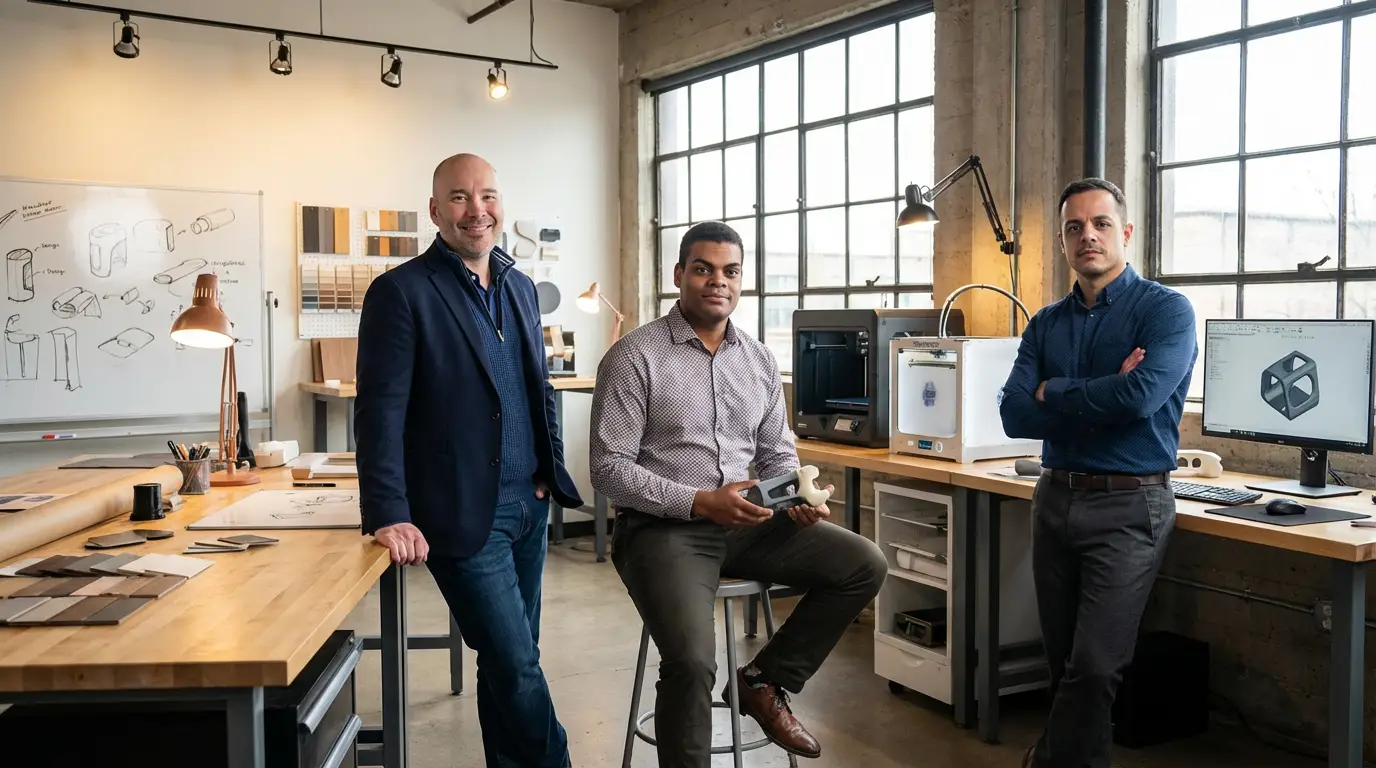
Eduardo Leardini
Head of Product Development, ONMOTIO
[ A NOTE FROM THE STUDIO ]
"Strategy is the part of the work that does not survive being delegated to a deck."
We have shipped the products we planned, paid the tooling bills, negotiated the MOQs, and watched the first production run come off the line. That experience is what we sell when teams hire us for strategy. Not slides. Not frameworks. The decisions we have already had to make once.
The best strategy work we do never looks like strategy. It looks like a roadmap that holds, a BOM that quotes the way we modelled it, and a launch that arrives on the date we wrote down a year earlier.
[ WHY ONMOTIO ]
Why teams hire us for strategy.
Strategy by people who have shipped.
Most product strategy consultants have never released a physical product. Our work is informed by the direct experience of designing, engineering, manufacturing, and launching dozens of hardware products. We know where programs actually fail because we have rescued the ones that did.
Costs grounded in supplier quotes.
BOM models built from real factory quotes and supplier visits, modelled at 1K, 10K, and 100K units. Pricing strategy and margin targets are then defended against numbers that survive contact with the purchasing department.
A factory network already vetted.
Established relationships with contract manufacturers across China, Taiwan, Vietnam, and Europe. Sourcing, qualification, and contract negotiation are part of the engagement, not a referral to figure out alone.
Fractional Head of Product when needed.
For founders without a senior hardware lead, we step in as fractional Head of Product or Technical Program Manager. We coordinate design, engineering, and the factory, and we hand back to your team when you have hired the permanent role.
[ MORE PROJECTS ]


