
[ MECHANICAL ENGINEERING ]
Engineered to survive contact with reality.
We turn design intent into production-ready assemblies that hold under load, pass under inspection, and manufacture under cost pressure. From FEA through DFM, GD&T through pilot run, we engineer hardware that ships the first time and stays shipped.
200+ assemblies delivered across aerospace, transit, consumer, and industrial. Regulated work for FDA, CE, UL, and CN-class compliance. Engineering behind eXalt Aircraft, HiRail Leasing, and SolarSmart Mower.
[ IS THIS FOR YOU ]
Mechanical engineering with us is the right next step if…
[ A GOOD FIT ]
- You have a working concept that needs to become a manufacturable, certifiable product.
- You need structural validation (FEA, fatigue, thermal) before committing to tooling.
- You're standardizing engineering across multiple product variants or chassis platforms.
- You need to meet regulatory requirements (FDA, CE, UL, CN, FAA, DOT).
- Your existing design works in CAD but fails on the factory floor.
[ PROBABLY NOT ]
- You only need form and aesthetics → Industrial Design
- You haven't validated the product concept yet → Product Strategy
- You only need a one-off prototype, not a production design → Prototyping
- You need pure firmware or electronics with no mechanical complexity → Electronics & Firmware

[ IN PRACTICE ]
HiRail: Standardizing the unstandardizable.
HiRail converts standard truck chassis, from Ford F350s up to Freightliner 10-wheelers, into rail-maintenance vehicles compliant with Canadian National's documentation standards. They needed one engineering system that worked across every chassis variant. We built the structured PDM, standardized the configuration drawings, integrated the hydraulic and electrical systems for onboard cranes, stabilizers, and rail signalling, and ran weight-and-balance analysis across the full platform range.
5+
Chassis platforms unified
100%
CN documentation compliant
Validated
Weight & balance, full range
Self-run
Internal team trained on PDM
[ POINT OF VIEW ]
How we approach mechanical engineering.
Four principles that shape every engineering project we run. Engineering rewards focus over breadth, so we are short and clear about what we believe in before we touch a CAD model.

Simulate before you tool.
Always.
Static, dynamic, fatigue, thermal. Running simulation before tooling costs hours. Fixing a structural failure after tooling costs weeks and tens of thousands. We run FEA on every load-bearing assembly, and we validate simulation against physical testing whenever the application is critical.
Tolerance stack-ups beat wishful thinking.
Most assembly problems on a factory floor trace back to nominal-dimension thinking that ignored worst-case stack. We model statistical tolerance from day one, predict assembly yield before the first part is made, and design GD&T schemes that the factory can actually inspect.
Documentation is the deliverable, not the byproduct.
GD&T per ASME Y14.5, full BOMs, mold flow reports, FEA validation packages, manufacturing drawings that leave nothing to interpretation. The handover document is the product. If the next team can't run with it, the engineering didn't ship.
Manufacturable beats elegant.
A clever mechanism that requires three custom fasteners and a special jig isn't engineering, it's a vanity project. We optimize part count, simplify assembly sequence, and use standard hardware wherever possible. The most beautiful assembly is the one that goes together in 30 seconds without instructions.
[ THE PROCESS ]
The validation gates.
Five gates. Each one closes a category of risk before the next phase begins. We do not move forward on optimism, we move forward on evidence.
- 01Requirements
- 02Architecture
- 03Simulation
- 04DFMEA
- 05Release
Requirements Capture
Functional, environmental, regulatory, and cost-target requirements captured in a formal Engineering Requirements Specification (ERS). Load cases defined. Service-life expectations agreed.
Architecture & Concept
Decisions on fastening, sealing, thermal management, assembly sequence, serviceability, and platform strategy. Multiple approaches evaluated using Pugh matrices.
Detailed Design & Simulation
Full parametric CAD with GD&T. Mold flow simulation for injection-molded parts. FEA validation on every load-bearing assembly.
Design Review & DFMEA
Formal design review and Design Failure Mode & Effects Analysis. Failure modes identified, ranked, and mitigated through design controls.
Validation & Release
DVT/PVT testing support. First article inspection. Production data package release. We stay involved through the first production run.
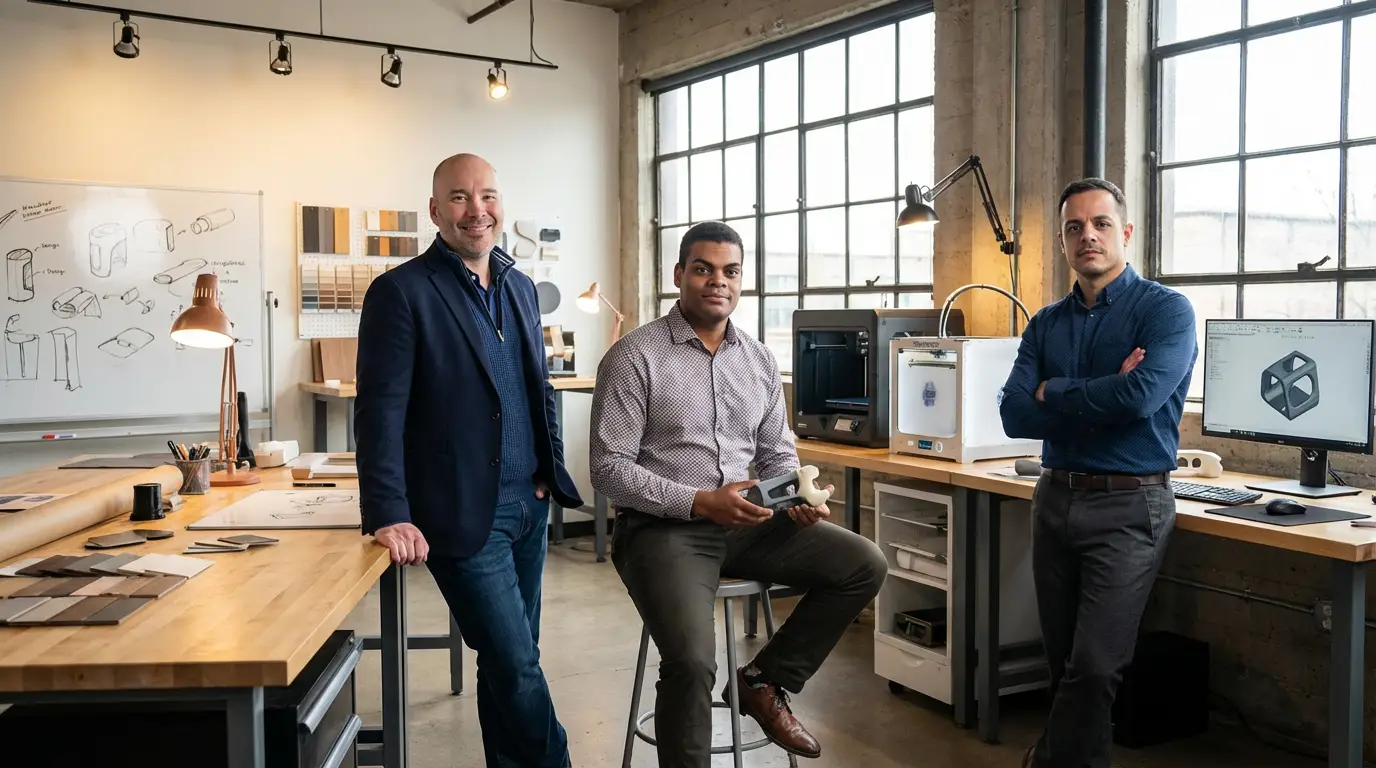
Eduardo Leardini & Izek Therrien
Head of Product Development · CEO & Co-Founder
[ THE TEAM ON THIS ]
The engineers who'll lead your project.
Eduardo leads our mechanical engineering practice, partnered with Izek on every engagement. Their backgrounds span aerospace, automotive, rail, and consumer electronics. Disciplines where you can't fake the work, the regulator is the customer, and the tolerance has to hold.
On a typical mechanical engineering engagement, Eduardo runs the project directly with two-to-four engineers depending on scope, and Izek stays in the design reviews from Gate 01 through to first article inspection. No farmed-out work, no surprise account managers.
Eduardo Leardini, Head of Product Development · Izek Therrien, CEO & Co-Founder
[ WHY ONMOTIO ]
Why teams hire us for mechanical engineering.
Engineering and design on the same model.
Most engineering vendors receive a CAD file at the door and start fresh. Our engineers worked on the same parametric model alongside our designers from week one. No "the design didn't account for this" surprises. No re-skinning to accommodate engineering compromises after the fact.
Regulated industries are home turf.
We've shipped work in aerospace (eXalt), transit infrastructure (HiRail), and industrial equipment. Our documentation meets FDA, CE, UL, and CN-class standards out of the box because we've done it before, not because we're learning on your project.
Simulation is grounded in physical testing.
FEA without correlation is theatre. We validate simulation against real-world testing on every critical application, and we adjust our simulation models when reality says otherwise. The result: you can trust the numbers we ship.
We finish the job at the factory.
Many engineering firms walk away at the data package handover. We stay involved through DVT/PVT, first article inspection, and the first production run. The engagement ends when the product ships at quality, not when the drawings are released.
[ MORE PROJECTS ]


