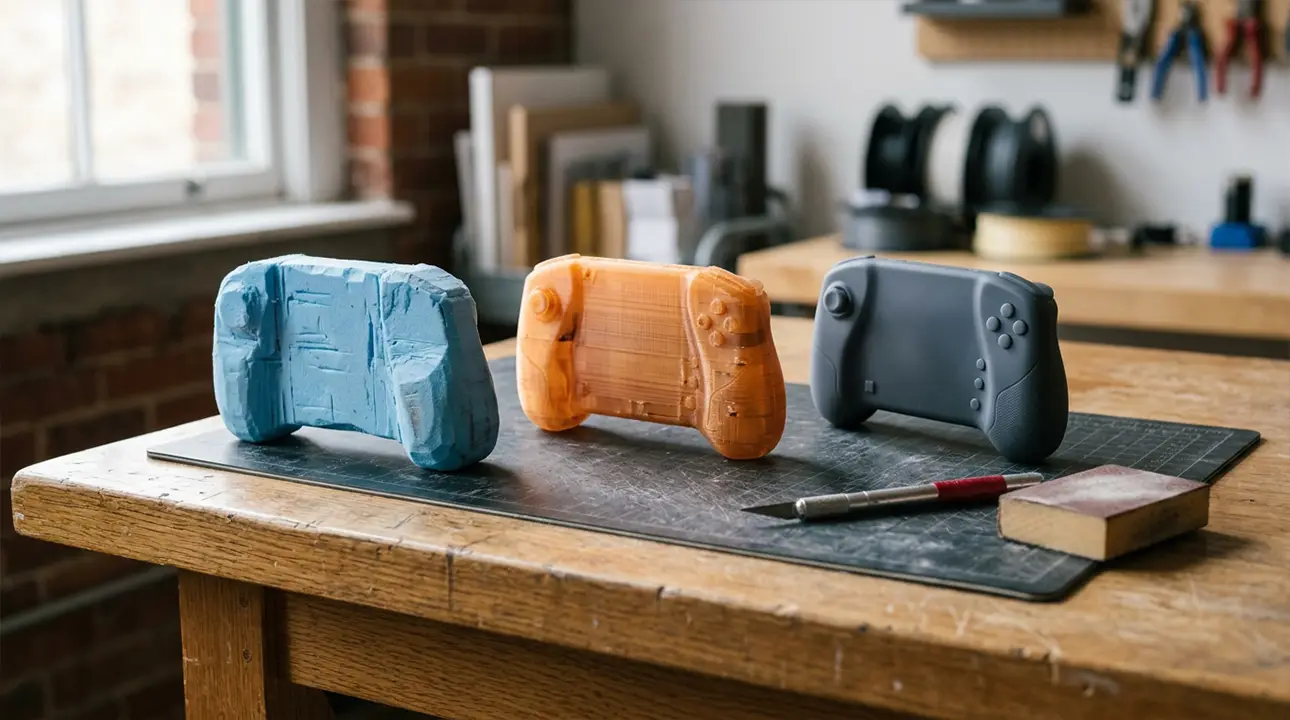
[ Prototyping guide ]
Which prototype do you need first?
There is no single "prototype". There are four, and each one answers a different question. Build the one that answers the question you can't answer yet, and you only pay for it once.
By Clement Simon, COO & Co-Founder of ONMOTIO
[ Quick answer ]
Build a proof of concept (POC) if you don't know whether the idea works. Build a looks-like prototype if you don't know whether people want it. Build a works-like prototype once you know both, to prove it works in its real form. Cast a small batch of 10 to 200 units when you need products in people's hands before a production mould.
[ Prototype path finder ]
Six questions. Your next build.
Answer for your product as it is today. The route moves with every answer and stops where you are.
It changes how each prototype is built.
Your route
Starts with one question.
Answer on the left. As soon as we know whether the principle works, the route lights up to the prototype you need next, and tells you why.
[ The four prototypes ]
Each one answers one question.
| Your open question | Build | It won't tell you | How we build it | On our projects | |
|---|---|---|---|---|---|
| 01 | Does the idea actually work? | Proof of conceptA rough rig that tests the one principle the product depends on. | Whether people want it, or whether it fits the final volume. | Off-the-shelf parts, 3D printed brackets, a development board. | 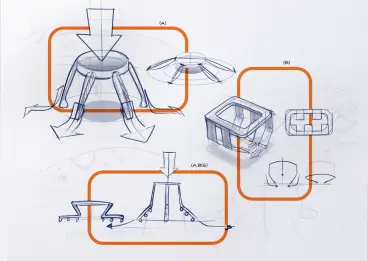 OrpheyRetractable EEG electrodes in a headphone OrpheyRetractable EEG electrodes in a headphone |
| 02 | Will people want it? | Looks-likeThe final shape, colour and finish, with nothing inside. | Whether the engineering fits inside it. | Machined or printed, then finished and painted. |  KORUIndiegogo campaign, over ten times its goal KORUIndiegogo campaign, over ten times its goal |
| 03 | Does it work in its real form? | Works-likeThe real mechanism, electronics and battery in the real volume, tested until it fails. | Whether it can be made in numbers at the right cost. | CNC parts and casting close to production materials; custom PCBs and firmware. | 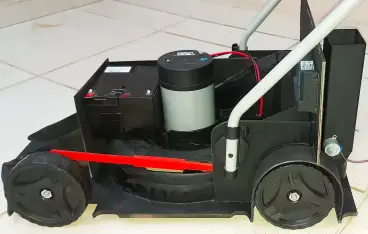 PhotonixField-tested on a CNC chassis PhotonixField-tested on a CNC chassis |
| 04 | Can we make more than one? | Small batch10 to 200 units cast from one master part, before any production mould. | The unit cost of mass production. | Vacuum casting and gravity casting, in our own workshops. | 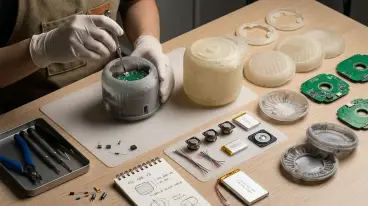 In the workshopCast enclosures before tooling In the workshopCast enclosures before tooling |
[ Why the order matters ]
The same change, made later.
Every prototype on this page happens before the tool is cut. That is the whole point of them: find the problem while a change still costs a new print, not a new tool.
Most of what a hardware project costs is not the work. It is the work done twice.
[ Common questions ]
Before you build.
What founders ask us most about prototypes, answered the way we answer them on a first call.
Choosing
Can I skip the proof of concept?
Only if the principle your product depends on has already been proven in a similar form. If it relies on a new mechanism, a sensor in an unusual place or a heat source in a small volume, start with a POC: every model you build without it is a bet.
Is a beautiful model proof that the product works?
No. A looks-like prototype tells you if the size, grip and finish are right. It says nothing about whether the mechanism, electronics and battery fit inside it. That is the job of the works-like prototype.
Which prototype do I need for a crowdfunding campaign?
The campaign page runs on how the product looks and what it does: a looks-like prototype and photoreal renders. Backers will expect delivery, so the works-like has to be on its way before the campaign, not after it.
Making
What are vacuum casting and gravity casting?
Two ways to make small batches before a production mould. From one master part, we make a mould and cast typically 10 to 200 units in materials close to the final plastic: enough for beta testers, certification samples or the first backers, without paying for steel tooling.
Do you build prototypes with electronics inside?
Yes. We regularly build prototypes with custom PCBs, off-the-shelf development boards, sensors, displays and full firmware: fully functional, not cosmetic shells.
What if the prototype reveals a design problem?
That is exactly why we prototype. Every build comes with a test plan, and every issue is documented with its root cause and the design change it calls for in the next iteration.
Cost and terms
How much does a prototype cost?
Single appearance models start in the low four-figures. Functional integrated prototypes, with mechanical parts, electronics and firmware, start in the low five-figures. Small-batch programmes of 10 to 200 units are scoped separately, based on quantity and finish.
How fast can a prototype be made?
Simple FDM prints in 24 to 48 hours, CNC-machined parts in typically 5 to 7 days, and fully assembled functional prototypes in 2 to 4 weeks, depending on complexity and component lead times.
Who owns the prototype and its IP?
You do. Once the final invoice is paid, the prototype IP and the physical units are yours. An NDA can be signed before you share any detail.
[ Next step ]
Not sure where you are?
A first call takes thirty minutes. You leave it knowing which prototype to build next, and what it should prove.
The full process, from brief to factory: How to develop a physical product. How we build prototypes: Prototyping.